


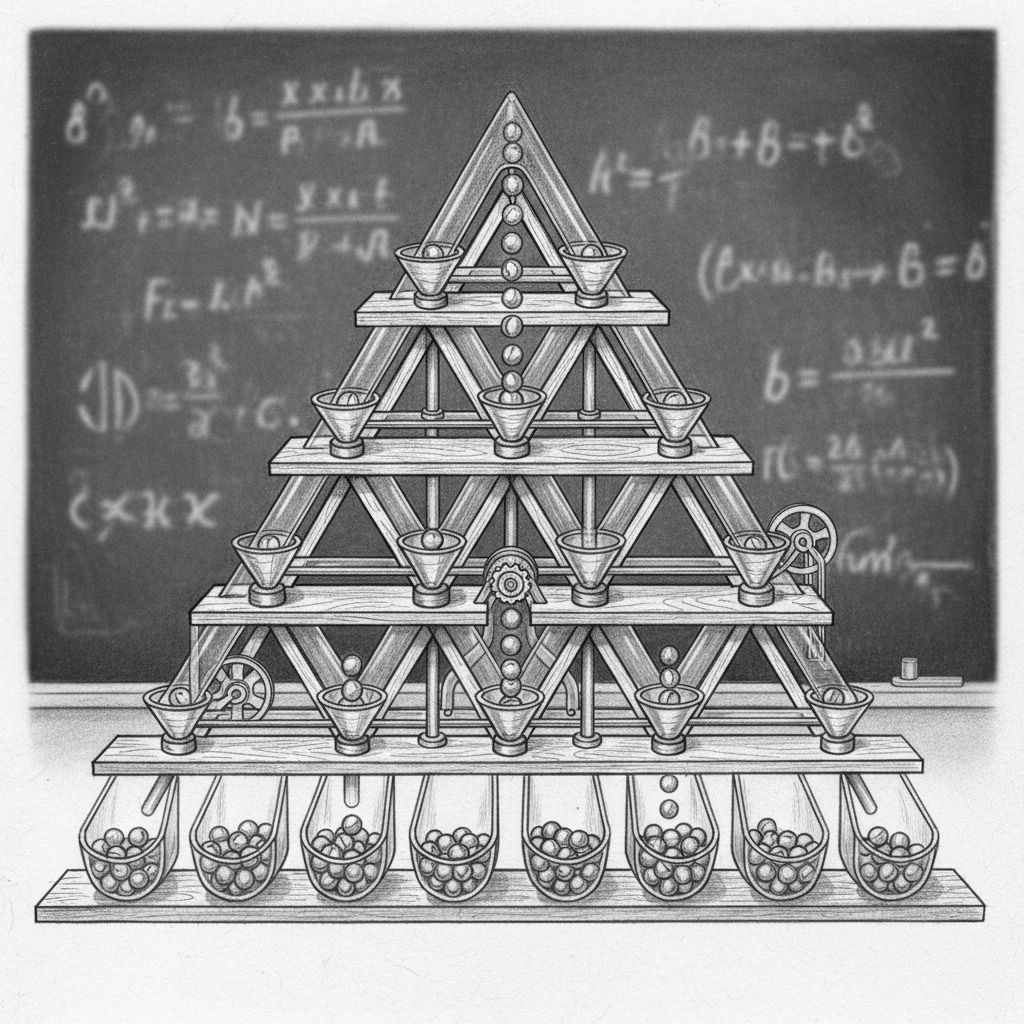
Welcome to "Binomial coefficient as a marble run – Mathematics to touch”! In this article we present an innovative marble run based on the modular system Marble Castle. This special marble run works similarly to a Galtonboard, but the marbles do not fall by chance, but always alternately to the left and right. This results in an exact binomial distribution that vividly illustrates the concept of Pascal's triangle. Immerse yourself in the world of mathematics and discover how playful learning works!
Structure and operation
In the picture you can see a constructed marble run, which consists of several components. Start with the base plates that you can puzzle into each other to create a stable base.
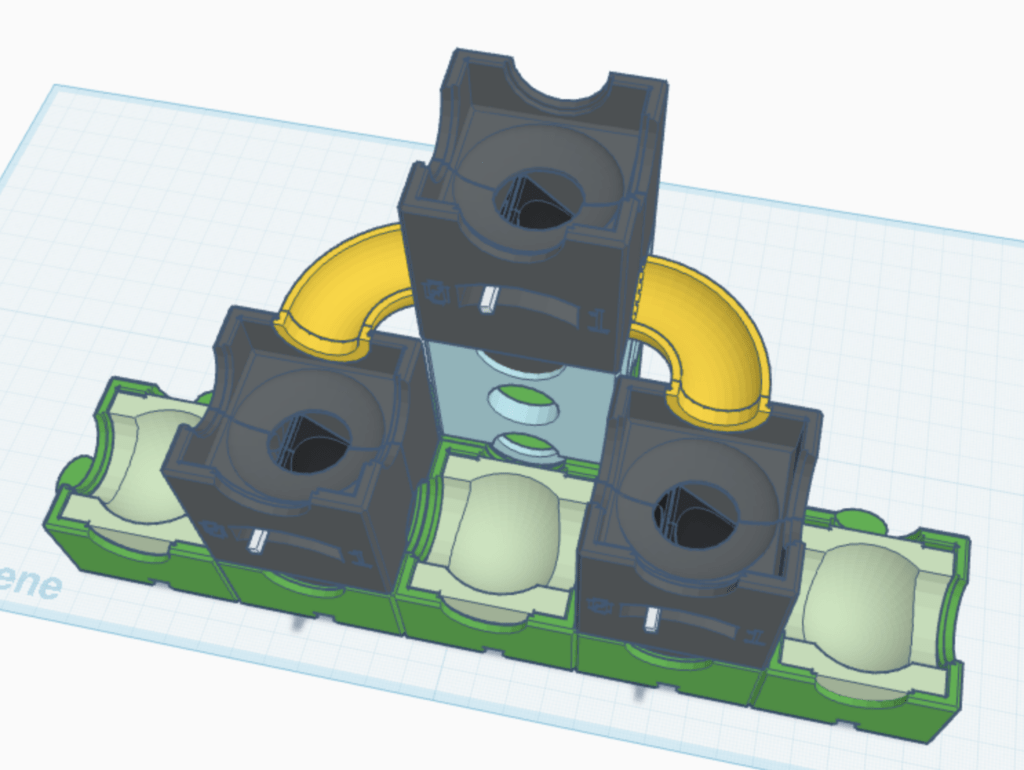
Then place the vertical building blocks on the base plates. Before you put on the top block, insert the curved webs, as this block locks the webs and holds them securely in place.
After the curved webs are inserted, you can put on the top block. Now the marble run is fully assembled and ready for the marbles. Watch them roll through the track!
0.The binomial formulas
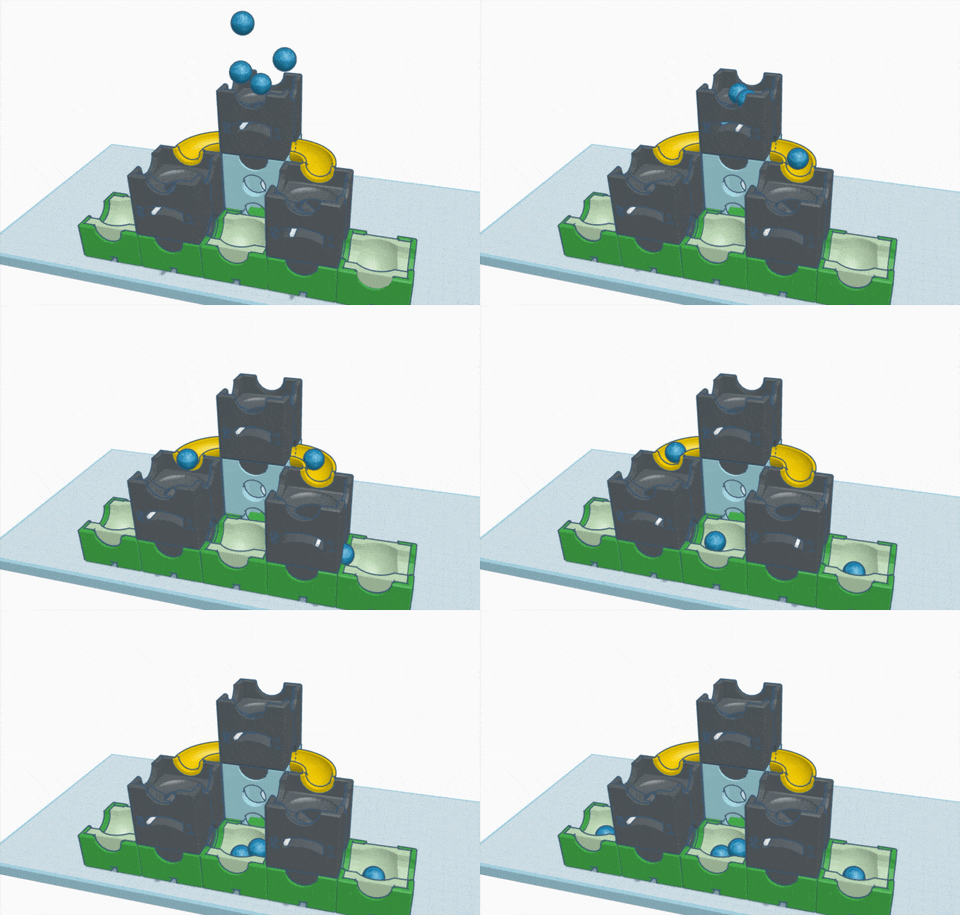
The marble run illustrates the coefficients (numbers before the letters) of the binomial formulas.
If you take the as the marble falls to the left (the pointer is on 1) and the as the marble falls to the right (the pointer is on 0), the coefficients of the binomial formula correspond to the number of marbles in the target compartments (for one complete run, i.e. until the pointers are back to the starting value, the easiest way is to set all the pointers in the same direction at the beginning).
This is because you can only get into the outer fields if the marble falls twice in the same direction, so there is only one path at a time. The marbles enter the middle field, which corresponds to the mixed term, via two paths.
System scalability
The marble run system is flexible and scalable, which makes it possible to adapt the construction to different values of . While the current model illustrates the binomial coefficients for , the system can be easily extended to show or higher values.
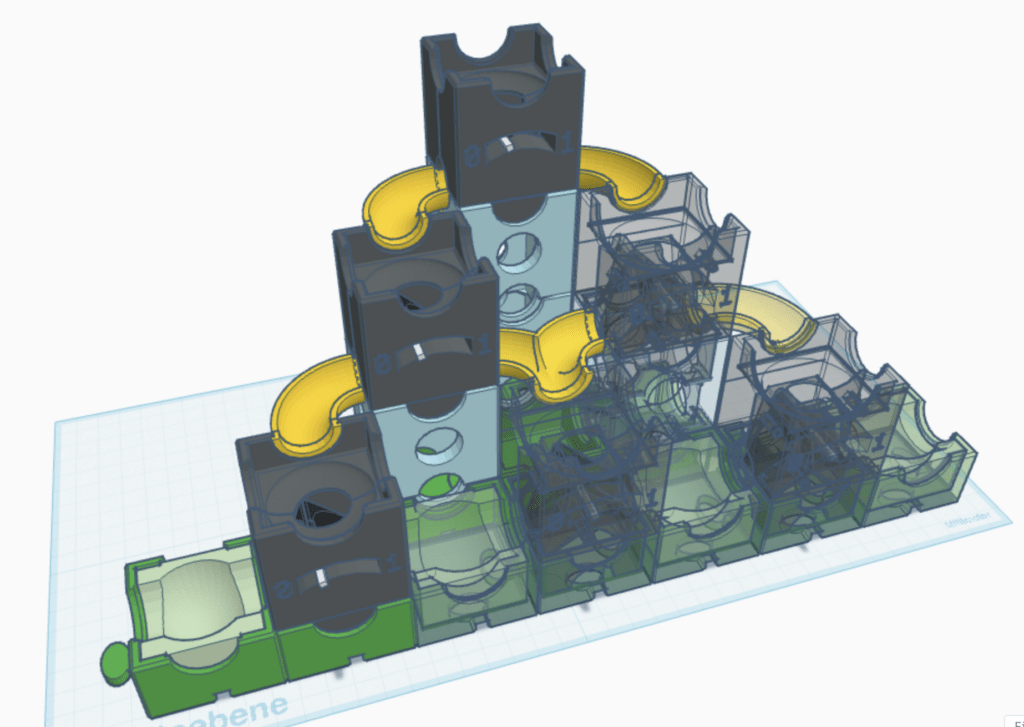
To demonstrate the scale, simply add additional vertical building blocks and floor plates. These new elements make it possible to enlarge the structure and integrate more marbles.
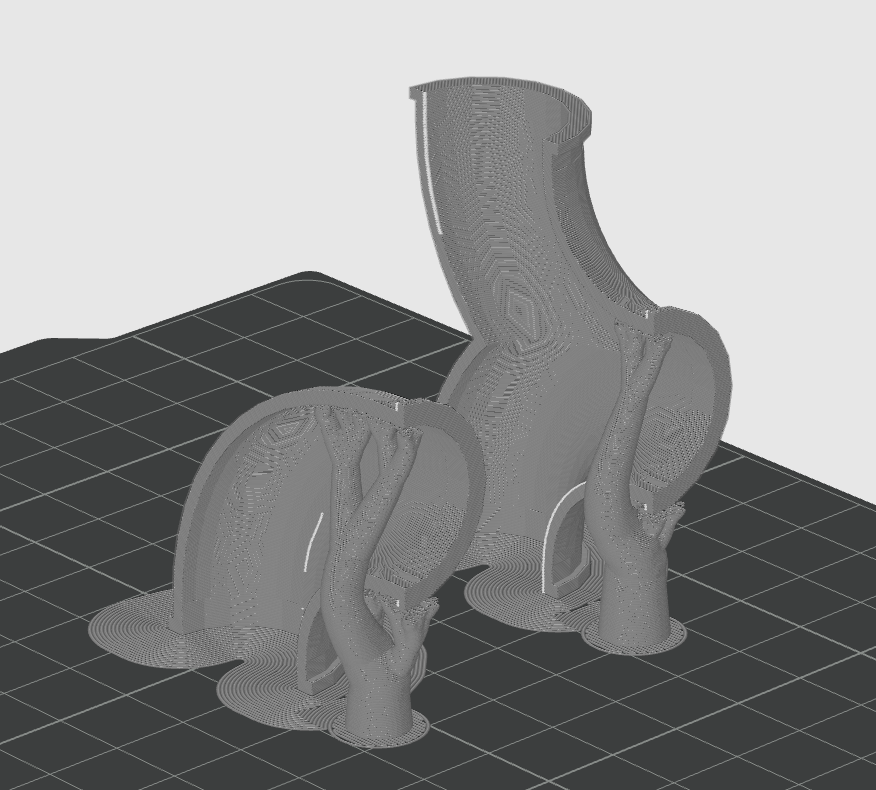
The curved tracks must be replaced by an extra component (see below for the download) if the marbles have to roll from two building blocks into one underlying building block.
The distribution of the marbles in the target fields after a pass also indicates the coefficients of the binomial formulas of higher degree. The degree corresponds to the height of the marble run. The exponents of and are determined by the number 'left' or 'right' of the paths of the marbles.
Binomial coefficient
The binomial coefficient is a fundamental mathematical variable that indicates how many possibilities there are to achieve results in . It is often used in binomial formulas and is crucial for understanding probabilities and combinations.
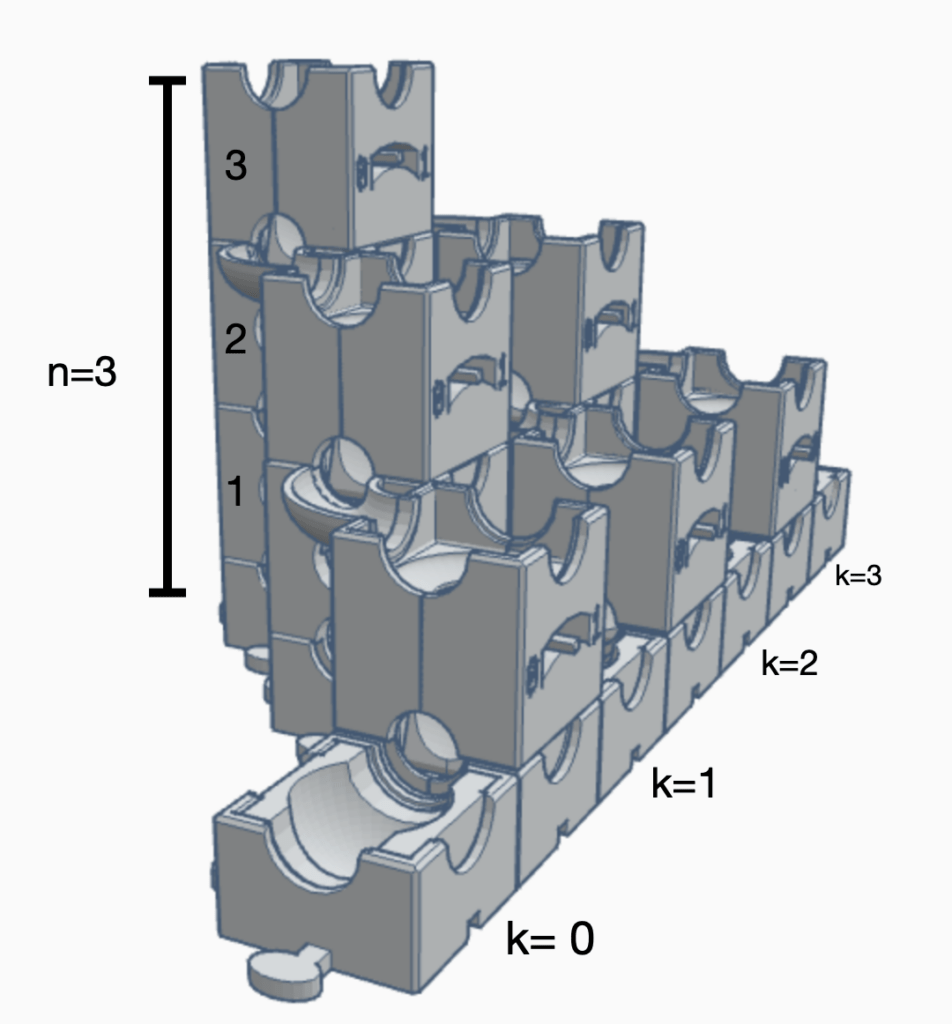
The binomial coefficient can be read directly in the marble runway. The height of the marble track corresponds to the value of , while in the -th target field the searched frequency can be found. This starts in . Field and counts from to . The number of marbles that land in the target field after a pass indicates the binomial coefficient.
Pascal's triangle
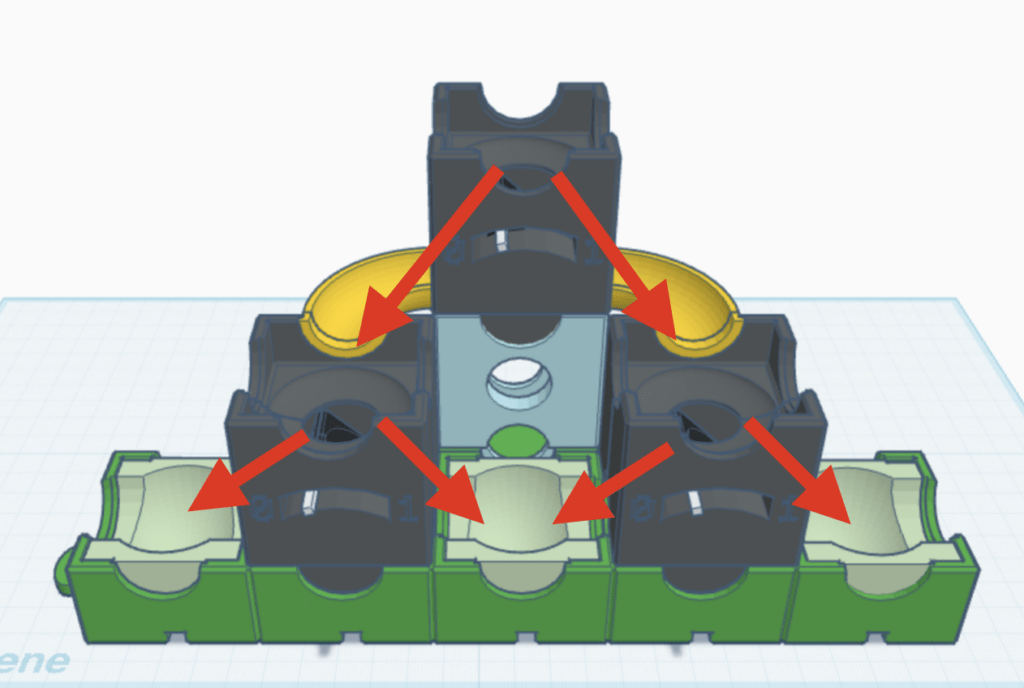
Pascal's triangle is a visual representation of the binomial coefficients and shows how they are arranged in a structured arrangement. In the image you can see the different layers that correspond to the values of . Each number in the triangle represents the number of possibilities to achieve attempts to achieve success in .
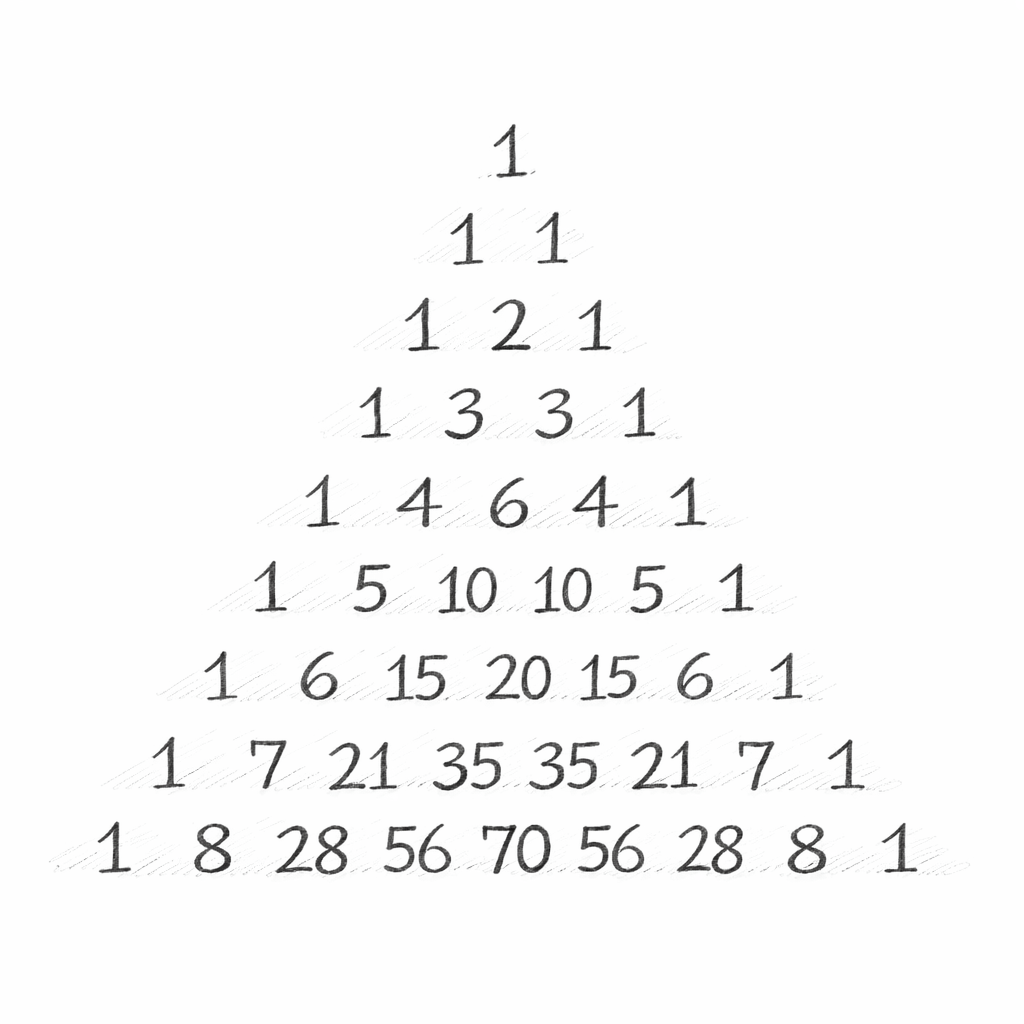
The numbers in the triangle are created by the sum of the two numbers directly above them.
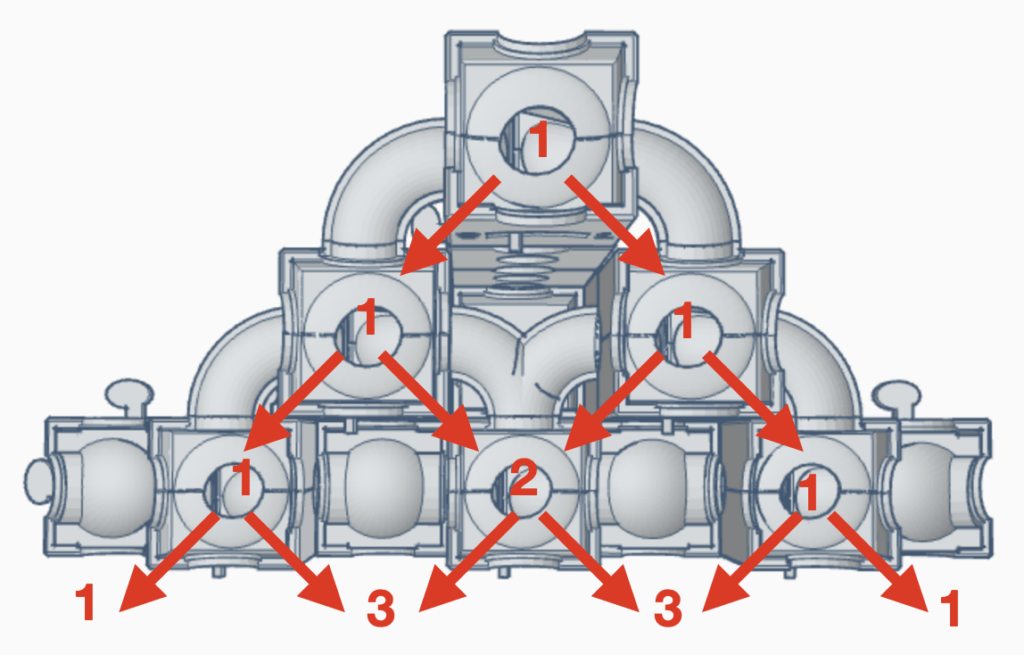
These sums form the values in the direction of the arrow and illustrate how the different combinations of the marbles are related. The image shows how the marbles land in the target fields and map the binomial coefficients.
Result
The marble run offers an innovative and illustrative way to capture complex mathematical concepts such as the binomial coefficient and the Pascal's triangle. Through playful experimentation with the track, users can experience the underlying principles of probability calculation and combinatorics up close.
The modular design makes it possible to expand the system flexibly and to explore different values of . This makes mathematics not only more understandable, but also more entertaining. Ultimately, the marble run shows how interactive learning methods can promote the understanding of mathematical relationships.


Required parts
For the construction of the marble run you need the components of the Murmelburg binary counter. These parts are specially designed for the construction of the marble run and allow easy assembly.
In addition, you need extra parts to be able to set up the marble run according to this article.
Leave a Reply